THE CRUNCH GROUP
primary phone: +1 (401) 863 3694
secondary phone: +1 (401) 863 1594
web: http://www.cfm.brown.edu/crunch
Division of Applied Mathematics
182 George st, Box F
Brown University, Providence
Rhode Island, RI 02912, USA

home  ::  directions  ::  contact  ::  credits  ::  fluid mechanics  ::  applied math


Research Projects of the CRUNCH Group:


Walk Through Arteries

In this project we are developing, in collaboration with our Computer Science colleagues, immersive interactive environments for computational steering. This requires the seamless integration of parallel computers running the code NEKTAR with computer graphics codes driving a Cave environment . Our current emphasis is on simulating and interacting with blood flows inside arteries for atherosclerosis applications, bypass grafts, etc (quick browse). In addition to this specific emphasis on biomedical flows, we are concurrently working towards building components of a general computational steering and visualization package which would be applicable to all flow scenarios that NEKTAR can simulate - incompressible flows, compressible flows, plasma flows, and fluid-structure interaction problems, and would allow for hierarchical visualization by taking advantage of the modal representation used in NEKTAR. Such applications include the flight of an F15 in the Cave (quick browse).

[ Particle Flurries: Synoptic 3D Flow Visualization ]


Multiscale modeling using Dissipative Particle Dynamics (DNA and other polymers).

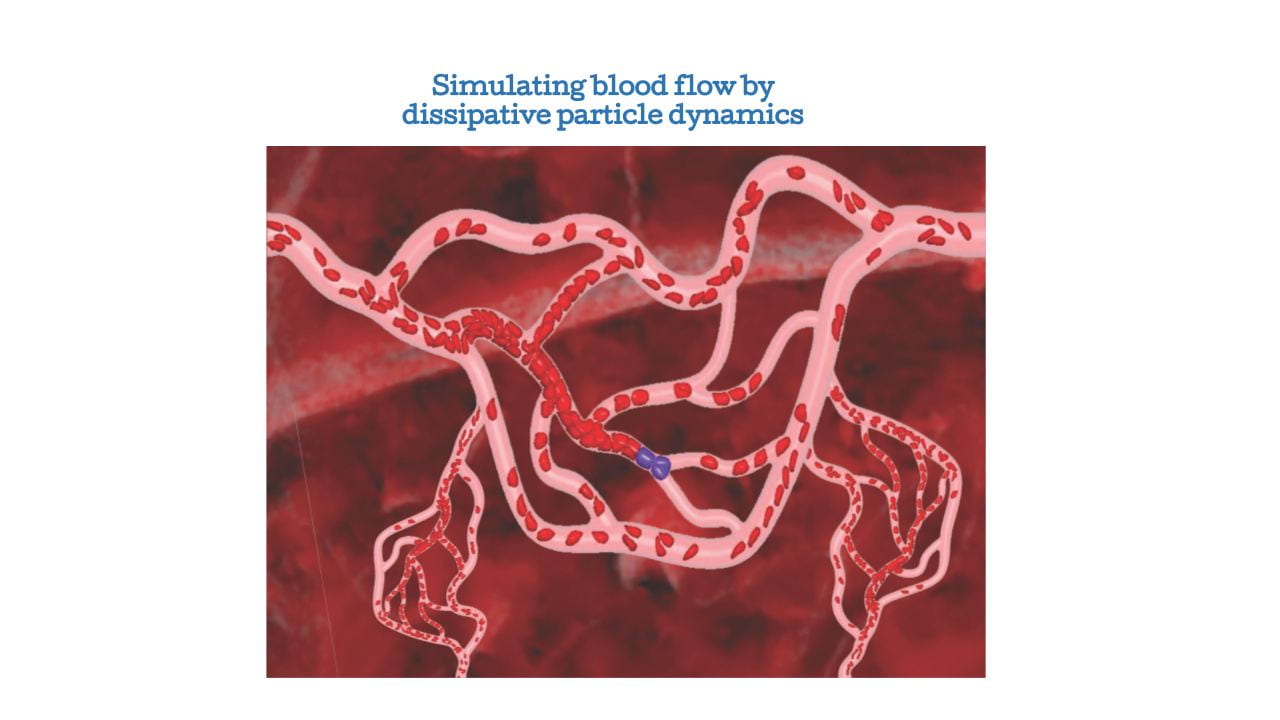
Dissipative Particle Dynamics (DPD) is a mesoscopic simulation method between molecular dynamics and continuum hydrodynamics. It can simulate efficiently complex liquids and dense suspensions using only a few thousands of virtual particles and at speed-up factors of more than one hundred thousands compared to molecular dynamics. DPD can be thought of as a coarse-grained version of Molecular Dynamics (MD), but it employs dissipative and stochastic forces to account for the eliminated degrees of freedom. The initial model was proposed by Hoogerburgge and Koelman in 1992 as a simulation method to avoid the artifacts associated with traditional Lattice-Boltzmann simulations while capturing spatio-temporal hydrodynamic scales much larger than those achievable with MD.

We use the basic DPD framework in order to formulate, implement and compare different types of bead-spring models (including FENE and stiff/weak Hookean springs) for polymer chains in dilute solutions. We develop time-staggered integrating schemes that efficiently address the issue of different timescale resolution requirements for the monomer-monomer and solvent interactions. Using these integrators in micro-domains our goal is to examine realistic force combinations and map the DPD-computed quantities onto standard macroscopic experimental and/or theoretical results.

There are, however, several open issues that need to be addressed so that DPD can fully realize its potential. They relate to boundary conditions, complex-geometry domains, high-order time integrators, and validation against available experimental results. To impose the no-slip boundary condition, for example, in this method is not a trivial matter as the soft potentials allow for particles to escape the domain; hence, we develop special procedures based on the wall-fluid inter-particle forces.

Related Publications:

  • CiSE 2005 [pdf, 692KB]
  • PRL 2005 [pdf, 136KB]

 polymers flowing freely in slovent DPD particles


Flying Bats in a CAVE

In order to further understand the aerodynamics of bat flight, we are performing numerical studies of air flow around moving bats To generate the associated complex geometries, we import data collected by tracking bat flight in a wind tunnel. This data is provided by researchers in the Evolutionary Biology Department (Professor Sharon Swartz). We then create 3D meshes using GRIDDGEN and simulate flow using the code NEKTAR. To accomodate the large deformations of the wing geometries during flight, are using FlexALE (Arbitrary-Lagrangian-Eulerian) formulation of NEKTAR. In addition, we are collaborating with researchers in the CS department (Professor David Laidlaw) to achieve 3D interactive visualization of the flow data in the CAVE.


[ Movie of flying bat ]
[ Meshes from different frames of the simulation ]
[ Gridgen Newsletter front page: page 1 | page 2 ]


Modeling Uncertainty with Polynomial Chaos

We are working in developing fast methods for quantifying uncertainty of physical parameters and boundary/initial conditions in flow simulations and other applications. To this end, we have employed the polynomial chaos ideas of N. Wiener but extended them to include a "smart representation" of randomness. This is related to the choice of the spectral representation, so instead of the Hermite Chaos of Wiener we have developed a general approach based on the entire Askey family of orthogonal polynomials and corresponding functionals. The applications include propagation in random media, flow-structure interactions, microfluidics, compressible flows, magnetohydrodynamics and other generic stochastic PDEs. The speed up factor in obtaining numerical solutions is one thousand to one million faster than Monte Carlo. For more information please click here and see the modified Nektar (s-NekTar) capabilities.


[ "Noisy flow past an oscillating cylinder" cover of Physical Review Letters (Vol. 92, No. 15) ]


Stochastic Shock Dynamics

 
The aim of this project is to model the effect of random inflow disturbances as well as the effect of random roughness on the shock dynamics. The work involves the development of multi-element generalized polynomial chaos (ME-gPC) methods in conjunction with the Discontinuous Galerkin Solver implemented in NekTar. To this end, we have reformulated the compressible Navier-Stokes equations within the stochastic framework, and considered prototype problems of classical aerodynamics, such as the stochastic piston problem, the two-dimensional supersonic flow past a wedge, and the three-dimensional supersonic flow past a cone. In parallel, we are deriving semi-analytical stochastic solutions for these problems based on stochastic perturbation methods in order to verify the solution and evaluate the accuracy and efficiency of ME-gPC and other stochastic numerical methods. For a representative paper, please see The stochastic piston problem", published in PNAS 2004.


DNS and LES of Flow-Structure Interactions

Simulation results + details

In this project we develop high-order methods for simulations of flow-induced vibrations in flows past bluff bodies. Th bluff bodies can be of arbitrary shape but most of our work so far has been on long flexible cylinders both linear and nolnilear. We have published systematic studies to investigate the near-wake dynamics of turbulent flow past rigid and flexible circular cylinders at Reynolds numbers ranging from 100-4000. The parallel simulations were performed using spectral/hp methods implemented in the incompressible Navier-Stokes solver NekTar. The simulations have been complemented with proper orthogonal decomposition (POD) approach, in order to systematically quantify the contribution from the coherent motion to the mean flow and the Reynolds stresses.The low dimensionality found in the near wake may be utilized to reduce the computation cost of simulations by using the 10 to 20 most energetic modes in non-linear Galerkin POD.


Unstructured Spectral Element Methods for Incompressible Flows

Spectral and spectral element algorithms on triangular and tetrahedral domains have been developed for simulations of transition and turbulence in complex-geometry flows. Direct numerical simulation and modern dynamical systems techniques (e.g. Proper Orthogonal Decomposition, Approximate Inertial Manifolds, Stokes eigenfunctions) are combined to study the dynamics of transitional and turbulent states of prototype flows in geometries such as cylinders and spheres, expansion steps, and grooved channels. These algorithms and the corresponding automated mesh generation methods have been implemented in the new generation of spectral/hp element codes NekTar .


Discontinuous Galerkin Methods for Compressible and Plasma Flows

Existing algorithms for transonic/supersonic flows are based on low-order techniques and involve crude models for turbulence modeling. This project involves the development of a hybrid spectral multidomain algorithm for direct and large-eddy simulations of compressible turbulent flows in the presence of shocks. The formulation is based on discontinuous Galerkin methods, and more can be found in the relevant book by Bernardo Cockburn, George E. Karniadakis and Chi-Wang Shu, entitled Discontinuous Galerkin Methods: Theory, Compuration and Applications. These methods are L2-stable and thus they do not require explicit flux limiters to preserve monotonicity. In addition, they offer high degree of parallelism and extend the good properties of finite volumes to high-order accuracy in the context of element-wise variational formulation. They form a natural candidate for LES approaches with built-in subgrid filtering based on their inherent monotonicity. The latest work involves the development of two-temperature plasma codes, please see the paper A Discontinuous Galerkin Method for Two-Temperature Plasmas published in CMAME.


Arbitrary Lagrangian-Eulerian Methods for Fluid-Structure Interactions

This project involves the development of moving meshes in three dimensions as well as the coupling of motions between flexible structures and fluids. This is done with a fast algorithm that is based on ideas from graph theory. The unstructured spectral element discretizations developed under NekTar are used here to provide flexibility in adaptive re-meshing. Applications include prediction of motion and stresses on freely vibrating structures subject to dynamic flow loading (e.g. F15/F22' flexible components), effects of particles on turbulence structure, the energy-harvesting eel, etc.


Cross-Site Simulations on the TeraGrid and Bencmarking

TeraGrid (TG) ( http://www.teragrid.org ) integrates the most powerful open resources in USA , which at the present time amount to about 50 teraflops in processing power and 1.5 petabytes of online storage connected with 40 Gigabits/second network. Unlike conventional supercomputers, it offers the opportunity for potentially unlimited scalability. The key question, however, that computational scientists are faced with is how to adapt their application to such complex and heterogeneous network effectively. We are working closely with computer scientists at the Argonne National Labs to develop middleware that can facilitate the transition from a single supercomputer to the TeraGrid. In particular we have focused on the use and further development of MPICH-G2, which can greatly relieve the computational scientists from low-level details of communication handling, network topology, resource allocation and management on the grid. We have performed the first cross-site simulations on the TeraGrid focusing on two grand-challenge problems: The first one is drag crisis in turbulent flow past bluff bodies while the second problem involves simulations of blood flow in the entire arterial tree. The first one is characterized by tightly coupled comuunication on different TeraGrid sites whereas the second one involves fairly loosely coupled cross-site communications. Some details can be found in this CiSE paper; also see NEKTAR-G2 and the human arterial tree project.

We have been benchmarking all parallel computers since the mid-eighties using kernel type programs for CPU and communications as well as applications codes. In particular, we are interested in implicit codes with global dependencies and complexities typical of high-order methods. We address the "algorithmic divide" that exists between explicit and implicit codes by developing parallel MPI-C++ codes based on both approaches and evaluating at all levels CPU and communications performance. Our current interest is on adaptive (self-tuned) algorithms that take advantange of the multiple memory levels on diverse platforms.


Turbulent Drag Reduction Technologies.

We are currently studying three different ways of obtaining turbulent drag reduction targeting an amount of 30% or higher. The first approach involves the use of traveling waves in the transverse (cross-flow) direction confined within the viscous sublayer. A full article describing these techniques can be found in Science, Volume 288, Number 5469, Issue of 19 May 2000, pp. 1230-1234. Here is the abstract and here is the full text of the article.

The second one involves the use of polymers with applications to complex-geometry turbulent flows.

The third one involves the use of micro-bubbles in conjunction with polymeric additives. In all cases we use the spectral/hp element method with specific enhancements based on recent algorithmic developments in our group. For example, we employ a semi-Lagrangian time stepping algorithm that allows for much larger time steps. We also employ a super-collocation procedure followed by Galerkin projection that controls aliasing errors on arbitrarily non-uniform grids. These developments allow for efficient simulations of high Reynolds number turbulent flows in complex geometries not possible by other approaches.


[ FY2005 request for computer and information science and engineering - page 228 ]
[ article on microbubble drag reduction - NCSA ]


DPIV-Driven Simulation: A New Computational Paradigm.

We have developed a new simulation approach (based on Karhunen-Loeve ideas) that employs a trial basis formed directly from experimental data (e.g. Digital-Particle-Image-Velocimetry, DPIV). To this end, we use non-linear Galerkin projections for the Navier-Stokes and energy equations where the most energetic modes form the "dominus" modes whereas the high modes act as "servus" modes following the dynamics of the dominus modes. We have shown that for coupled flow-heat transfer problems this approach leads to efficient and asymptotically stable low-dimensional models without the need for ad hoc eddy-viscosity models.


Microflows and Nanoflows: Fundamentals and Simulation

Here we develop models and algorithms for gas, liquid and plasma flows in complex microgeometries. Our earlier work focused on gases but we are now concentrating in bioparticulate flows in microchannels and also in developing micro-pulsed-plasma thrusters (micro-PPTs). The algorithms we develop are a mixture of continuum and atomistic methods with appropriate interfaces for the mesoscopic regime. The macro-models we develop are based on data extracted from full simulations applied as either modified boundary conditions or modified transport coefficients. A new thrust is the development of mesoscopic methods, like the Dissipative Particle Dynamics method (DPD) that bridges the scales between the atomistic and continuum regimes. Based on DPD we study dynamic self-assembly and colloidal microdevices as well as more fundametal issues related to phase transitions of soft matter, coarse graining and multiscaling. For more information see the book Microflows and Nanoflows: Fundamentals and Simulation (for Springer link click here) .